Fitting in is a performance. It’s reading the room before you walk in, adjusting your volume, your vocabulary, your affect. It’s knowing which parts of yourself are welcome and which ones you leave at the door. It works. It’s gotten a lot of us very far. But it comes at a cost, and that cost is cumulative.
Last month I joined the Asian Mental Health Collective for a conversation on exactly this, and what struck me most wasn’t just what we talked about — it was what happened in the room while we talked about it. People who had never met recognized themselves in each other. Different backgrounds, different specific experiences of being Asian-American, and still: the same quiet vigilance, the same question underneath so many interactions — am I too much, or not enough? One participant said it plainly: “When I belong, I’m no longer the quiet Asian.” Another, near the end, said they left feeling inspired and validated just to be themselves. That’s not something content can replicate.
The term code-switching comes from Black communities, who named something real and named it precisely: the labor of shifting language, tone, and presentation to navigate spaces that weren’t built for you. Asian Americans know this labor intimately, even if we’ve inherited the language for it secondhand. We toggle between worlds constantly — family expectations and professional personas, cultural fluency at home and legibility at work, the version of ourselves that belongs somewhere and the version that’s trying to fit in somewhere else. Code-switching is active and adaptive. It’s reading a room and knowing how to move in it. Masking is something different — it’s suppression, hiding the parts of yourself that feel unwelcome or unsafe, and it tends to cost more because you’re not just adapting, you’re disappearing. Both are responses to real conditions. Neither is a character flaw. But they’re worth distinguishing, because the path forward looks different depending on which one you’re doing.
There’s a particular shape this takes in Asian-American communities. The model minority framework doesn’t just stereotype us externally — it gets internalized. Overwork becomes a baseline because we learned early that we had the most to lose and couldn’t afford to be anything less than exceptional. Perfectionism runs so deep it shows up even in our own healing. People-pleasing becomes the logic of belonging: being useful is how you earn love, how you justify your presence, how you stay safe. These are socially sanctioned adaptations — behaviors the world rewards enough that we stop questioning whether we chose them.
But they’re running on fear.
And fear, as I’ve put it before, is a fossil fuel. It burns dirty.
The unlearning is real work, and it comes with real grief — not as a metaphor but as an actual experience of loss. Grief for the parts of yourself that got compressed to fit spaces that weren’t made for you. Grief for not having had the room to ask earlier: who am I beyond what’s expected of me? How we were raised informs who we think we are. For many of us, there wasn’t space to examine that. Our parents’ survival frameworks came wrapped in love, and untangling them is delicate, slow work. That’s part of why being in a room with other Asian Americans who are asking the same questions matters as much as it does. You don’t have to explain the starting conditions. People already know.
I said something in that conversation that I keep coming back to: so much grief in discovering who we are, so many layers to uncover and unravel. But it’s also such a gift to share ourselves with those who love and understand us.
Part of finding that gift is recognizing that no single community has to hold all of you. This is something I write about in my book, The Hyphenated Life — the experience of living with one foot in multiple worlds, of being a hyphenate. That’s not a problem to solve. Different parts of you may find home in different places: a specifically Asian-American space for one set of experiences, a queer community for another, a subculture or creative community for something else entirely. Love is expansive. It doesn’t have to look one way.
What that requires is showing up — not a grandgesture, just consistency. Toe-dipping questions that let people in a little. Following through. Coming back. There’s a difference between being part of a community and having close friendships, and both matter. Community is the broader container, the room where the starting conditions don’t need explaining. Friendship is the depth that grows when you keep showing up inside it. Neither happens without the repetition.
Not every space will be able to hold the full complexity of who you are, and that’s okay. The code-switching, the toggling, the ability to bring different parts of yourself into different rooms — that’s not a burden or a compromise. For those of us who have spent our whole lives moving between worlds, it’s also a kind of fluency. The goal isn’t to stop moving. It’s to make sure some of those rooms actually feel like home.
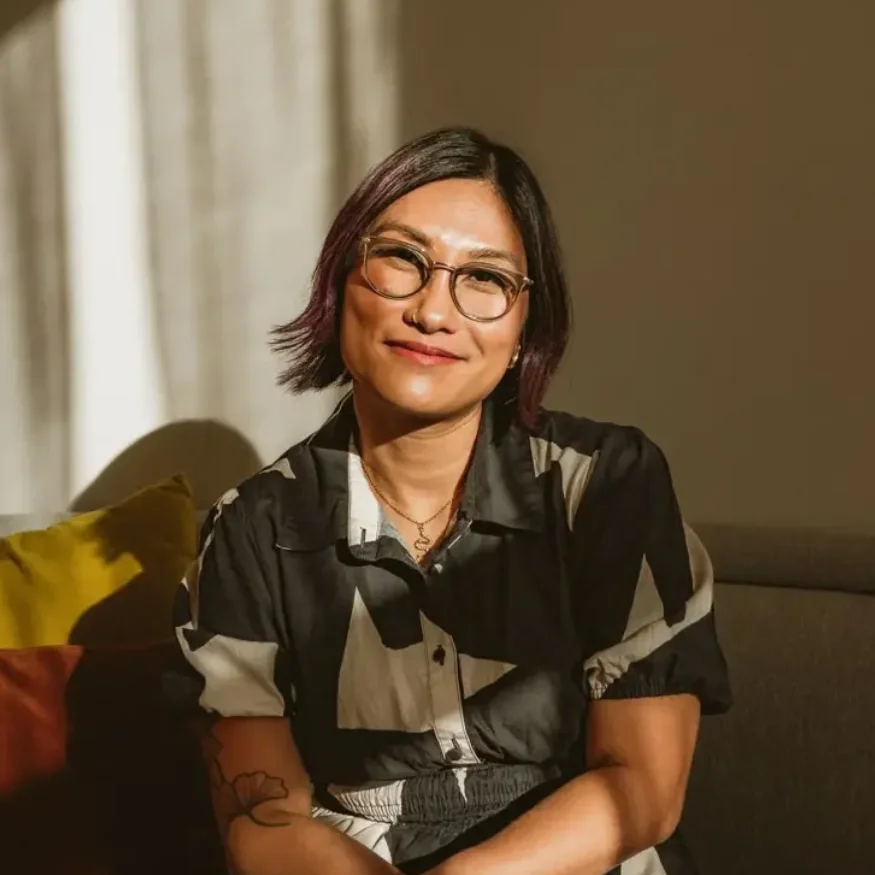
Dr. Han Ren is the author of The Hyphenated Life, June 2026 from Balance. Follow her on Instagram for more of her work and reflections.
About Dr. Han Ren
Dr. Han Ren is a proud Hyphenated human and professional—licensed clinical and school psychologist, speaker, educator, content creator, author, 1.5-generation Chinese-American immigrant, neurodivergent mind, mother, partner, and only child (which explains a lot).
Rooted in anti-oppressive liberation psychology, Dr. Ren works from an interpersonal, culturally humble, and systems-informed framework. She is committed to making mental health accessible and resonant, especially for historically overlooked communities. Through her widely viewed social media content, she translates complex psychological concepts into everyday wisdom with humor and compassion. Her work centers fellow Hyphenates, helping those who live between cultures, identities, and expectations move from the margins toward their own growth edges.
Dr. Ren earned a doctorate in child clinical and school psychology from the University of Texas at Austin, a master of education in special education from the University of Houston, and a bachelor of arts in psychology from the University of Michigan. A lifelong educator, she has served as an adjunct professor at UT Austin and began her career teaching pre-K special education in a Title 1 school as part of Teach for America.
Her work has been featured on the TEDx stage, the Headspace app, NPR, Healthline, and other major media outlets. Whether she’s supporting clients, teaching workshops, or giving keynote talks, Dr. Ren brings a blend of clinical expertise, cultural attunement, humor, and deep commitment to collective healing and community care.
Outside of work, you’ll find Han traveling to explore new food scenes, seeking out sunshine, and dancing (enthusiastically and offbeat) to live music. She lives in Austin, Texas, where she coleads Pivot Psychology Austin, a group private practice dedicated to inclusive and affirming care.